- Oasis center Princess cars building - 1st Floor - Unit 13-14 Sheikh Zayed Rd - Al Quoz - Al Quoz 1 - Dubai
- info@secureverse.ae
Secureverse Leading Interior Design and Fit-Out Company In UAE

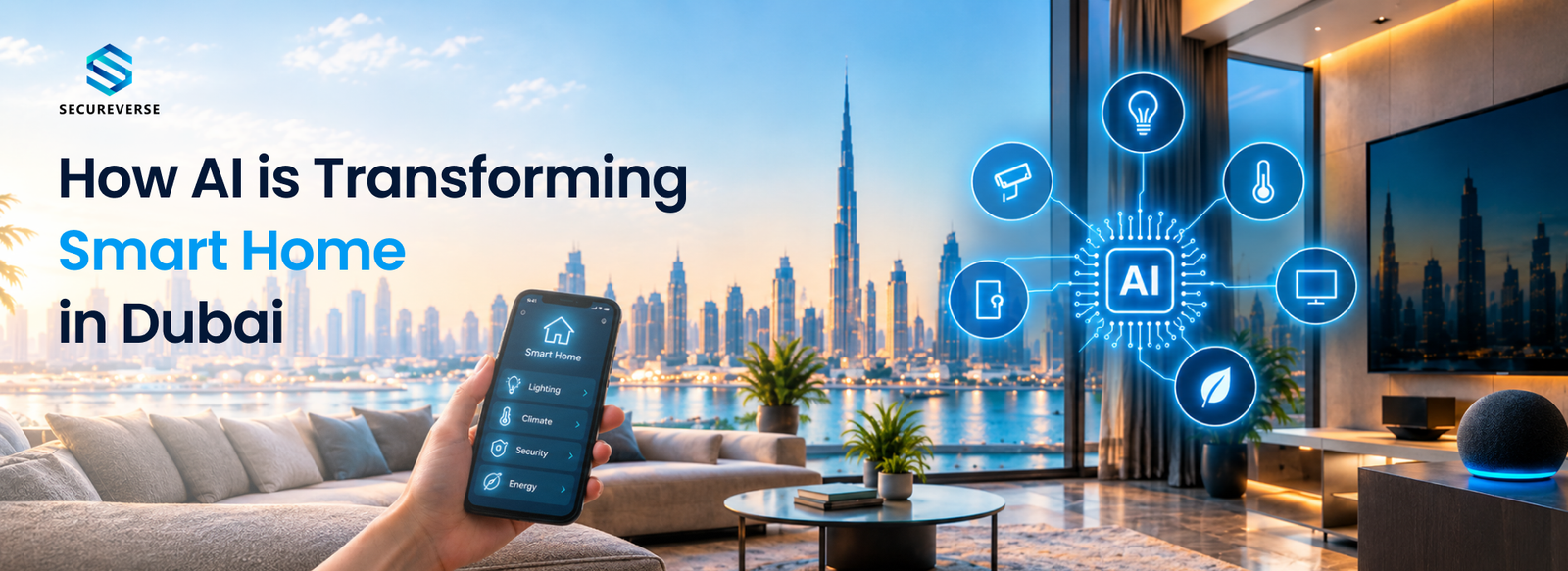
Smart homes in Dubai are becoming more sophisticated. Homeowners are no longer looking only for remote-controlled lights or automated curtains. Increasingly, they want homes that can respond to routines, improve convenience, support security, and create a more comfortable living environment.
This is where artificial intelligence (AI) is changing the way smart homes are designed and used.
Traditional home automation generally follows predefined instructions. For example, a light may turn on at a scheduled time or curtains may close when a particular command is given. AI can take this further by using information from connected devices and user interactions to support more adaptive automation.
For homeowners, this creates an important design consideration. Smart technology should not be added randomly after the interior has been completed. Wiring, networking, device locations, sensors, control systems, lighting, and equipment should be considered alongside the interior design.
An experienced Interior Design Company in Dubai can help coordinate the visual and functional aspects of a home, while System Integration in Dubai can bring different technology systems together. When these requirements are considered during an Interior Fit Out Dubai project, technology can be integrated more naturally into the finished space.
An AI-powered smart home is a connected residential environment where artificial intelligence uses information from devices, sensors, user preferences, and routines to support more responsive automation and personalised control.
A conventional automated home may perform actions based on fixed commands. AI-enabled systems can potentially analyse patterns and adapt certain functions according to how the home is being used.
For example, a smart home may use connected devices to understand:
The exact capabilities depend on the technology platform, connected devices, configuration, and privacy settings.
The goal is not necessarily to automate everything. Instead, AI can help homeowners create an environment where technology works more naturally in the background.
AI is transforming smart homes in Dubai by making automation more adaptive, connected, and responsive across areas such as lighting, climate control, security, entertainment, and everyday household routines.
Dubai’s residential properties vary significantly, from apartments and contemporary villas to large luxury residences. Each property has different requirements, which means smart home technology needs to be planned around the space and the people using it.
Here are some of the main areas where AI can make a difference.
Lighting is one of the most visible elements of an interior and one of the most practical areas for automation.
AI-enabled systems can work with sensors, schedules, occupancy information, and user preferences to support lighting decisions.
For example, a homeowner may have different lighting preferences for:
Instead of relying exclusively on individual switches, selected lighting functions can be coordinated through scenes or automated routines.
This makes technology part of the interior experience rather than a separate feature.
Dubai’s climate makes indoor comfort particularly important. Smart climate systems can provide homeowners with greater control over temperature settings and schedules.
AI can potentially analyse usage patterns and help optimise selected climate settings based on occupancy, preferences, or established routines.
However, smart climate control still depends on the home’s HVAC equipment, controls, sensors, connectivity, and system configuration.
The benefit of proper planning is that climate controls can be incorporated into the wider smart home ecosystem rather than operating independently.
Security is another area where connected technology can play an important role.
Smart cameras, sensors, video doorbells, alarms, and access control systems can provide homeowners with information about activity around the property.
AI-powered technologies may assist with functions such as recognising patterns, identifying certain types of activity, or filtering alerts, depending on the system.
For a smart home, security should also be considered from an interior planning perspective.
Door hardware, sensor locations, equipment, wiring, power requirements, and network connectivity can all influence the final installation.
This is why System Integration in Dubai can be valuable when multiple security and automation systems need to work together.
AI works with home automation by analysing information from connected devices and using configured rules, preferences, or patterns to support automated actions and recommendations.
A simple way to understand the relationship is:
For example:
The actual operation depends on the technology platform and the devices connected to it.
AI does not replace the need for good system design. Poorly selected or poorly integrated devices can still create an unreliable smart home experience.
That is why technology planning is important from the beginning.
Different homes require different levels of automation. Some homeowners may want simple controls, while others may want a fully integrated smart environment.
| Smart Home Area | Possible AI/Automation Application |
| Lighting | Automated scenes, schedules, occupancy-based control |
| Climate | Temperature routines and selected adaptive controls |
| Security | Smart monitoring, alerts, cameras and sensors |
| Access Control | Connected entry systems and user permissions |
| Entertainment | Media control and personalised routines |
| Curtains & Blinds | Scheduled or automated operation |
| Energy Management | Monitoring and selected optimisation functions |
| Voice Control | Hands-free control of supported devices |
| Sensors | Occupancy, environmental and activity monitoring |
| Home Routines | Coordinated actions across multiple devices |
Not every property needs every feature. A well-designed smart home should solve real problems rather than simply add more technology.
AI and smart home technology should be considered during interior design because device locations, wiring, networking, sensors, control interfaces, lighting, furniture layouts, and equipment can affect both functionality and the appearance of the finished space.
For example, installing a smart lighting system may require consideration of:
Similarly, cameras and access control devices need suitable locations that provide the required functionality without unnecessarily affecting the appearance of the property.
A professional Interior Design Company in Dubai can therefore coordinate technology requirements with the design concept.
System Integration in Dubai connects selected smart home technologies into a coordinated environment, allowing compatible systems such as lighting, automation, security, audio-visual equipment, and access control to work together.
Without integration, homeowners may end up using multiple independent applications, controllers, or remotes.
A coordinated system can simplify the user experience.
For example, a single “Movie Night” scene could potentially:
The exact functions depend on the systems and devices installed.
The important point is that integration should be planned according to actual requirements rather than adding unnecessary complexity.
An Interior Fit Out Company in Dubai can help implement the physical elements required for a smart home, including selected electrical works, ceilings, wall finishes, joinery, equipment locations, and infrastructure needed for integrated technology.
Smart technology depends on more than software.
The physical environment must support it.
During an Interior Fit Out Dubai project, technology requirements can be coordinated with:
This approach can reduce the need for visible cables or last-minute modifications.
A Fit Out Company Dubai that understands technology coordination can therefore contribute to a more seamless final result.
A successful smart home should balance technology with aesthetics.
Consider a modern villa with a minimalist interior. Large numbers of visible switches, devices, cables, speakers, and equipment can affect the visual character of the space.
Technology planning can address this by considering device placement during the design stage.
1. CLIENT REQUIREMENTS
2. PROPERTY & LIFESTYLE ASSESSMENT
3. INTERIOR DESIGN CONCEPT
4. SMART HOME REQUIREMENTS
5. TECHNOLOGY & SYSTEM PLANNING
6. ELECTRICAL & NETWORK COORDINATION
7. INTERIOR FIT-OUT EXECUTION
8. DEVICE INSTALLATION & INTEGRATION
9. TESTING & CONFIGURATION
10. USER HANDOVER
11. ONGOING SUPPORT & MAINTENANCE
This approach allows interior and technology requirements to develop together rather than being handled as completely separate projects.
Before choosing smart home technology, homeowners should consider more than the number of devices.
Identify what you actually want to automate.
Do you need automated lighting? Better security? Entertainment control? Climate management? Or a combination?
Not every smart device works with every platform. Compatibility should be reviewed before purchasing equipment.
Smart homes depend on reliable connectivity. Network requirements should be considered during the design and fit-out stages.
AI-enabled devices can process information about household activity. Homeowners should understand what data devices collect, how it is processed, and what privacy controls are available.
Technology evolves quickly. A smart home should ideally have a practical approach to upgrades and expansion.
A smart home should make everyday life easier. If a system becomes unnecessarily complicated, the technology may reduce rather than improve convenience.
Yes, smart home technology can be incorporated during an interior fit-out, and planning it during the project can make electrical, networking, device placement, lighting, joinery, and equipment requirements easier to coordinate.
This is particularly useful for new interiors or major renovation projects.
For example, a media wall can be designed with space for screens, speakers, equipment, power, and connectivity.
Similarly, a kitchen or living room can be planned around lighting controls, sensors, smart appliances, and other connected devices.
This is where interior design and technology coordination become closely connected.
Smart technology is only one part of maintaining a property.
Secureverse’s broader service offering can also support other property requirements.
Interior design helps establish the layout, finishes, materials, furniture coordination, and visual direction of a property.
Roofing work can be important when a property requires roof renewal or related improvements. Proper planning can help protect the building and the interiors below from weather-related issues.
Automation and smart home solutions can support lighting, climate, entertainment, security, access, and other connected functions depending on the selected systems.
Routine property issues can arise after an interior project is completed. Handyman support can help address selected repair, installation, and maintenance requirements.
A clean environment helps maintain the appearance and usability of residential and commercial interiors. Cleaning can be particularly useful after fit-out work and as part of ongoing property care.
When choosing a smart home and interior partner in Dubai, consider its ability to understand your lifestyle, coordinate interior design and technology, manage installation requirements, explain system capabilities clearly, and provide appropriate support after completion.
A useful checklist includes:
The right partner should recommend technology based on your actual needs rather than simply adding features.
Secureverse can support property projects through interior, home automation, smart home, and related property services, helping clients coordinate design, technology, and ongoing property requirements.
Depending on the project scope, Secureverse services include:
| Service | How It Supports the Property |
| Interior | Space planning, design and interior requirements |
| Home Automation | Connected controls and automated functions |
| Smart Home | Technology-enabled residential environments |
| Reroofing | Roof-related renewal and improvement requirements |
| Handyman | Selected repairs and property maintenance |
| Cleaning | Interior and property cleaning requirements |
For projects involving smart home technology, the key is coordination.
Interior layouts, technology requirements, device locations, electrical infrastructure, networking, and user preferences should be considered together wherever practical.
AI is likely to continue influencing how people interact with their homes.
The future of smart homes may involve systems that become increasingly capable of understanding routines, recognising context, and coordinating different devices.
However, the most successful smart homes will not necessarily be the ones with the largest number of devices.
They will be the ones where technology is useful, reliable, secure, and easy to use.
For Dubai homeowners, this means smart home planning should focus on the property, lifestyle, climate, design, technology requirements, and long-term usability.
AI is changing smart homes from collections of connected devices into more coordinated environments. Lighting, climate control, security, entertainment, access control, and other systems can increasingly work together to create a more responsive home.
An experienced Interior Design Company in Dubai can help coordinate aesthetics, layouts, materials, lighting, and functionality, while System Integration in Dubai can bring compatible technologies together. An Interior Fit Out Company in Dubai can also help coordinate the physical infrastructure required to implement these solutions.
At Secureverse, we understand that modern properties require more than attractive interiors. Our services cover Interior, Reroofing, Home Automation, Smart Home, Handyman, and Cleaning, allowing clients to address different property requirements through a coordinated service approach.
Whether you are planning a new smart home, upgrading an existing property, or starting an Interior Fit Out Dubai project, the right planning can help create a space that is functional, comfortable, and technology-enabled.
Contact Secureverse to discuss your interior, smart home, home automation, reroofing, handyman, or cleaning requirements.
AI is making smart homes more adaptive by helping connected systems use information from sensors, devices, routines, and user preferences to support automated functions.
Yes. Depending on the existing devices and platform, selected AI-enabled features may be added or upgraded. Compatibility should be checked before implementation.
An Interior Design Company in Dubai can coordinate layouts, lighting, materials, furniture, device locations, and technology requirements so smart home features fit naturally into the overall interior.
System Integration in Dubai can connect compatible technologies such as lighting, security, entertainment, automation, and access control into a more coordinated environment.
Yes. Installing technology during an interior fit-out can make it easier to coordinate wiring, networking, lighting, sensors, equipment, and device locations.